
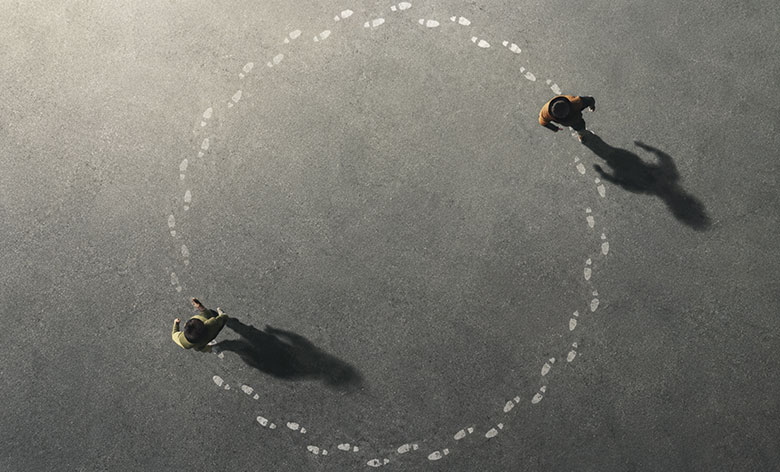
Why Do I Keep Doing This? The Question to Ask Before You Try to Change a Habit
Why Do I Keep Doing This? The Question to Ask Before You Try to Change a Habit
You've asked yourself this a thousand times.
After finishing a bag of chips when you weren't even hungry. After scrolling for an hour when you meant to be asleep an hour ago. After putting off the one thing you said you'd do all week. After snapping at someone you love. After pouring another drink, sending another impulse order, saying yes again when you meant to say no.
Why do I keep doing this?
You know what you want. You know how you want to show up. And yet, somehow, you find yourself back in the same pattern, again.
I lived that way for almost four decades. And for most of it, I believed the problem was a lack of discipline. That the fix was simple, if only I could just be stronger, more committed, more willing to white-knuckle my way through.
I want to offer you a different possibility today.
What if the habit isn't the problem?
What if the behavior actually makes sense?
You Are Not Broken. You Are Adaptive.
From the moment you were conceived, you began adapting to your environment, your circumstances, and the people around you. You adapted through your thoughts, your nervous system, and your behaviors. Over time, those adaptations shaped how you see yourself, how you relate to others, and the life you've built.
When I say that, people sometimes assume I'm talking about trauma. Sometimes trauma is part of the story. But it doesn't have to be. Adaptation is simply how human beings learn to navigate life.
A child raised in a home where achievement was everything may adapt by becoming relentlessly productive.
A child raised in an unpredictable environment may adapt by becoming hypervigilant, always scanning for the next problem.
A child who felt emotionally alone may adapt by learning to comfort themselves in whatever way was available.
Here's the part that matters most: almost every adaptation begins as a solution. It helped you manage something. Survive something. Get through something.
The challenge is that the solution you built years ago can become the very thing keeping you stuck today.
The Behavior You Want to Get Rid of Was Once Protecting You
Picture a child growing up in a home where emotions weren't particularly welcome. No one had to say the words "your feelings don't matter." Children learn through experience — through being told to stop crying, through being criticized for being upset, through caregivers who were too overwhelmed themselves to respond consistently.
Over time, that child's nervous system learns something specific: feeling this is not safe.
So the system finds a way to push the feeling down instead. Food. Screens. Constant busyness. Whatever works to create distance from what's underneath.
These are often the exact behaviors people spend years desperately trying to eliminate.
But here's the problem: trying to remove a behavior without understanding what it's been doing for you is like pulling the warning light off your car dashboard because you're tired of looking at it. The light disappears. The engine problem underneath does not.
Your habits work the same way. The behavior is a signal, not a flaw. And until the need underneath it is understood and offered something that actually works better, the behavior isn't going anywhere. It will persist, or it will resurface somewhere else.
Why Willpower Keeps Failing You
I spent decades trying to willpower my way out of emotional eating. I tried a thousand different ways to discipline myself. Following a diet felt easier than asking what was really underneath my need to turn to food for comfort.
But in the end, it was the unwillingness to understand that true need that made lasting change impossible.
I did eventually overcome it. Not by force, but by understanding. I learned to tend to my nervous system through somatic practice. I learned to feel my feelings instead of running from them. I learned to become my own inner resource. Those were the real solutions. Once I was willing to address them, I didn't just stop turning to food after nearly forty years. I learned how to give myself the attuned care I'd been needing all along.
Until you understand the need beneath the behavior, change will always feel like a battle. This is where so much of personal development quietly fails people. We're taught that motivation, discipline, and willpower will get us anywhere we want to go. But ask yourself honestly: has that actually worked for you? Maybe in short bursts. Not in any way that lasted.
You don't need more commitment. You don't need more accountability or effort.
You need to understand the need, and provide for it.
The Three Conditions That Make Real Change Possible
Lasting change isn't a matter of forcing your nervous system into a new pattern. It's a matter of creating the right conditions for it to shift on its own.
Those conditions are safety, capacity, and energy, the three pillars I lay out in my book, You're Not the Problem.
The same system that learned to reach for your unwanted behaviors is remarkably capable of learning another way. The same nervous system that developed protective patterns can develop healthier ones. It simply needs the right conditions to do it.
A Practical Place to Start
Think of one behavior you've been judging yourself for lately. Not one you're proud of, but one that frustrates you. One that makes you ask, why do I keep doing this?
Then get curious instead of critical.
What purpose might this behavior be serving?
What discomfort might it be helping me avoid?
What need might it be trying to meet?
What happens inside me right before I engage in it?
Notice what happens in your body as you sit with these questions. Tension. Sadness. Anxiety. A heaviness in the chest. An urge to move away from the feeling entirely. You don't need to fix or force anything right now. You're simply gathering data. Often the body holds pieces of the story the mind has been missing all along.
This Is Hopeful Work, Even When It's Hard
I know this asks something of you: to sit with hard questions and learn a new way of relating to yourself. But it also takes something off your shoulders.
You get to stop beating yourself up.
You get to stop pushing harder against a system that was only ever trying to protect you.
You get to offer yourself the care, compassion, and respect you deserve.
Self-compassion isn't the soft option here. It's the strategic one. Fighting against yourself consumes energy you don't have to spare and reinforces the very shame cycle keeping you stuck. Understanding the logic behind your behavior is what finally opens the door to something different.
Change that lasts was never going to start with criticism.
It starts with understanding what role the behavior has been playing and what need it's been quietly trying to meet all along.
If this resonated, I'd love to hear from you: what's one behavior you've struggled to change that makes a little more sense now, seen as an adaptation rather than a flaw? Drop it in the comments. You're not the only one carrying it.
You can go deeper into this work through the free resources on the blog, or explore the full framework, including the three pillars of safety, capacity, and energy, in my book, You're Not the Problem: End the Overwhelm, Restore Energy, and Make Progress that Lasts. Visit www.lorimontry.com to get started.