
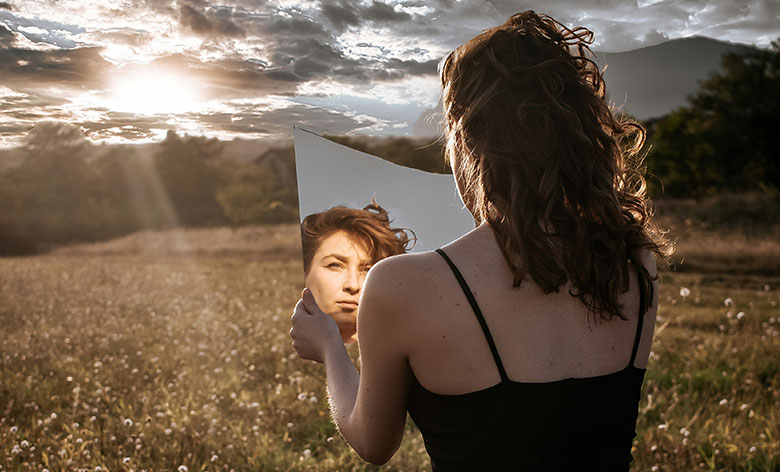
The Two Versions of You (And Which One Is Running Your Life)
The Two Women Living Your Life, and Only One of Them Is Really You
I want to introduce you to two women today. The interesting part is that they're both me, two different versions of me, with two entirely different ways of perceiving, thinking, feeling, and moving through a day. I think you'll recognize both of them, because all of us are carrying two versions of ourselves around, and which one happens to be driving on any given day can shape far more of your life than you'd expect.
We'll start with the one I lived as for most of my years. I call her my Adapted Self.
She woke up every morning already behind. Before her feet hit the floor, some part of her was already scanning the day for what was wrong, what might go wrong, and what she hadn't gotten to yet. That scanning wasn't a habit she chose. It was the lens she saw everything through, shaped by adaptations that had once kept her safe, and by the time I was living inside them, they had become the glasses I saw the whole world through. A delayed text read as rejection. A mistake read as complete failure. A challenge read as a threat instead of an opportunity. There was never quite enough time, never enough certainty, never enough of me, because that was simply how the world arrived when it came through that particular filter.
The thoughts that ran underneath all of it were relentless. I need to do more. I need to try harder. I need to be better. I need to not let anyone down. I need to stay productive and not make a mistake. And underneath every one of those thoughts was the same quiet promise: if I could just accomplish enough, fix enough, become enough, I would finally get to feel okay.
That promise created a constant undercurrent I lived inside without ever fully naming. Pressure. Guilt. A low hum of not-enough-ness that never really lifted. My nervous system rarely felt settled, because it believed there was always another problem to solve or another threat waiting around the next corner. Even when something good happened, I couldn't take it in all the way, because part of me was already scanning for what would go wrong next.
From that place, my behavior made complete sense once I understood where it was coming from. I overworked. I people-pleased. I turned to food, shopping, relationships, wine, or work whenever I needed comfort. I overthought every decision until it exhausted me. I procrastinated on the things that mattered most, because I genuinely didn't know where to start. I stayed busy, because slowing down meant feeling everything I had spent years trying to outrun.
And when life happened to me, I didn't really respond to it. I reacted. A hard moment pulled me straight into survival. Criticism felt devastating. Conflict felt dangerous. And the biggest one, the one that ran under almost everything else, was uncertainty. Uncertainty felt unbearable. Every reaction I had was really just an attempt to protect myself from a world my adaptations had convinced me was not safe.
That was my Adapted Self. She formed out of the circumstances of my early life, and then I built an entire adult life on top of her. I want to be clear about something here, because it matters more than almost anything else in this piece.
She wasn't bad. She wasn't weak. She wasn't broken. She was remarkably intelligent. She learned exactly what she needed to learn to survive the life she was living at the time. The real problem was never her. The problem was that adaptations built for survival were never designed to build the life I wanted.
Right around my fortieth birthday, I looked at that life and understood something needed to change. I had spent decades trying to fix myself through hustle, discipline, achievement, and no small amount of shame, and I had very little to show for the effort where it counted most. On paper, my life looked like a success story. I'd graduated from Harvard Law School. I had a corporate practice. I was raising kids I loved. I had a marriage. I lived in a beautiful home. From the outside, it looked like I had built a good life.
From the inside, it was not a good life. It was a battle. I had no peace. I didn't like my own body. I felt trapped by my obligations and couldn't find my way to joy, even in the parts of my life that should have held it easily. I had no real idea who I was underneath all the striving, because I had spent so much of my life becoming who I thought I needed to be that I'd lost touch with the person who was there the whole time.
That's what happens when adaptations become your instruction manual instead of your life.
I think of it now the way I used to think about building Legos with my son. Imagine opening a box that's meant to become the Eiffel Tower, except the instructions inside the box are for Buckingham Palace. You can work as hard as you want. You can spend hours trying to force the pieces to fit. None of it will matter, because the effort was never the problem. You were following the wrong instructions the entire time.
That's what I had been doing. At the time, I had no idea what the right instruction manual even looked like. I didn't know there was another version of me underneath the adaptations. I didn't know my nervous system was shaping the way I perceived myself, other people, and the world around me. I didn't know that every thought I believed, every feeling I experienced, every behavior I repeated, and every way I reacted to life was being filtered through adaptations that had once protected me and had long since stopped serving me. All I knew was that the life I'd worked so hard to build didn't feel like mine, and that realization sent me in a completely different direction.
Over the next fifteen years, I worked to understand something that changed the way I see myself and the way I see all of us as humans. I wasn't broken. I wasn't missing discipline. I hadn't failed to become someone. I had simply spent my life building from my Adapted Self instead of the other version of me that had been there all along.
That other version is who I call the Expansive Self, and she wasn't something I had to create. She had been waiting quietly underneath the adaptations that had once kept me safe. As I began creating more safety, more capacity, and more resources in my life, something remarkable started to happen. The adaptations that had been running the show for decades began to soften, and this other version of me started to emerge.
The Expansive Self sees the world through a completely different pair of glasses. She doesn't wake up scanning for what's wrong or bracing for what might go wrong next. She notices opportunity as easily as she notices problems. She sees a challenge as something to move through instead of proof that she's failing. She meets people with curiosity instead of assuming they aren't safe or don't like her. She doesn't need every situation to feel certain before she's willing to move forward.
Because she perceives the world differently, her thoughts are different too. Instead of asking How do I fix myself? she asks What do I need? Instead of wondering whether she's enough, she asks whether she's living in a way that feels true to who she is. She trusts herself to figure things out as she goes. She doesn't expect perfection from herself anymore, because she no longer believes perfection is what keeps her safe.
One was built by adaptation. The other was built by authenticity.
Her emotional life changed too, though maybe not in the way people expect. She still feels fear sometimes. Disappointment. Grief. Uncertainty. Those are simply part of being human, and they never fully disappear for any of us. The difference is that those feelings no longer define her reality or determine her next move. She can feel anxious without believing she's in danger. She can feel disappointed without deciding that everything is falling apart. She can sit inside uncertainty, most of the time, without abandoning herself in the middle of it.
From that place, her behavior changed too. She can rest. She can take a break without earning it first through guilt. She can speak honestly instead of managing what she says to protect what other people might think. She creates, not because she has to or because she's trying to prove her worth, but because something genuinely matters to her. She sets boundaries because they honor who she is, not because she's angry or trying to control someone else. She follows through on what she says, not out of force or shame, but because her actions line up with what genuinely matters to her. She doesn't reach for food, shopping, or wine to manage what she's feeling. Maybe once in a while, but mostly, she just feels it, and she has the capacity to stay present while she does.
She's also able to stay connected to what's happening inside her before survival takes over completely, which means she can meet herself with curiosity instead of criticism. And the most important difference isn't that her life became dramatically easier, although in a lot of ways it did. It's that she no longer faces her life alone.
Looking back now, I can see clearly that these were never just two versions of me. They were two entirely different ways of being in a life. One was built by adaptation. The other was built by authenticity. One organized itself around surviving. The other organized itself around living.
My guess is that as you've been reading this, you've recognized pieces of yourself in both of these women. Before you go, I want to leave you with one more thing to sit with, because it isn't always obvious which one is leading your life at any given moment. For a lot of us, our adaptations have been with us for so long that they don't feel like adaptations at all. They feel like personality. Like preference. Like strength or weakness, or simply the way things have always been. That was true for me too.
So here's what I'd ask you to consider. What if it isn't who you are? What if it's who you adapted to become?
Over the next week, get curious. Look at the places in your life that don't feel the way you want them to feel. Maybe it's a relationship. Maybe it's work, or money, or the way you talk to yourself when no one else is listening. Maybe it's the way you respond under pressure, or a dream you've been quietly afraid to pursue. Don't judge whatever you find there, and don't turn this into another thing to fix. Just get curious, and ask yourself one honest question: if my Expansive Self were leading this part of my life instead of my adaptations, what would be different?
Here's what I've come to understand after all these years of doing this work. Your life is built by the way you perceive yourself, other people, and the world around you. That perception shapes your thoughts. Your thoughts shape your feelings. Your feelings shape your behavior. And your behavior, repeated enough times, becomes the life you're living. If your adaptations are leading, you'll keep creating a life that reflects them. If your Expansive Self is leading, you'll begin creating a life that reflects who you really are underneath everything you learned in order to survive.
This is the framework I'll keep coming back to, because once you can see the difference between your Adapted Self and your Expansive Self, you start seeing it everywhere. It's the foundation of everything I write and teach, and it's the subject I go into in far more depth in my book You're Not the Problem, where I walk through how these adaptations form, how to recognize which version of you is leading at any given moment, and how to begin building the safety and capacity that let your Expansive Self take the lead more of the time.
You don't need to become someone else. You need the permission and the safety to become more fully who you already are underneath everything you adapted to be.
This is the first piece in an ongoing series on the Adapted Self and the Expansive Self. Continue with A Practice for Identifying Your Adaptations, or read Everything Doesn't Have to Be Okay for You to Be Okay to see this framework in practice on an ordinary, uncomfortable day.
Lori Montry is a somatic practitioner and the author of You're Not the Problem.